Monday, 16 January 2012

The House: The Principal Players

We finally had the house in our possession, but in could in no wise be considered habitable. By this stage, I was so heartily sick of the gloomy place where we had been living, that I laid down a deadline of three weeks before I would be in residence. Enter our motley but trusty crew who saw us through this initial "it has to get worse before it can get better" stage: our two leading men, ably and not so ably supported by a random selection of gophers, labourers, passing vagrants, visiting friends and family.

First and most definitely foremost comes Alain, our heating engineeer/plumber extraordinaire and general Mr Fixit. Alain had already saved our bacon in our previous house, by rectifying some hopeless work done by a rank cowboy (whom we sued). He was a compact, wiry and ruggedly handsome chap, with a sweep of white hair and a very French, bushy black moustache. He would cheerfully turn his hand to any job needing doing, could think of ways around problems and understood the need to economise where possible, all qualities of extreme rarity and value.

Alain was always accompanied on site by Mrs Alain and three or four of the junior Alains, who all looked identical and thus put us in mind of a set of Russian dolls. Although we came to know the family quite well  over the years, we never could work out exactly how many juniors there were. Mrs Alain had a penchant for extremely short skirts and high heels (not too practical as work-wear) and not a tooth in her head.
Alain (left) lends a hand with the endless rubble

Although slightly given to histrionics and a little too fond of pastis, Alain was our rock and our saviour on many occasion, and his magnificent heating system serves us faithfully to this day.


Fred works on one of the new doorways


Our second leading man was Fred, a rather mystical chap who appeared one day in response to our search for a stonemason. Fred drove and lived in an ancient ex-gendarme Renault van, was very proud of his distant Irish ancestry, played the fiddle like a demon, and made a bit of extra money teaching the handling of working horses at the local agricultural college. He was generally accompanied on site by his slightly unbalanced but very gentle Welsh Collie, often by his two absolutley delightful young daughters and occasionally by his elderly mother who, as far as I am aware, never spoke to anyone.


Fred's dog keeps watch on the pressure-washer


Since the purchase had been so badly delayed, we had had plenty of time to sort out all the necessary planning permissions, so as soon as the papers were signed, the gang went at it: ripping out floors, digging up the garden for the septic tank, bashing new doors and windows in the half-metre thick walls. By the time I moved in with eight-month-old babe (hubby had artfully arranged to be away in the UK at the time), we had one freshly painted and reasonably orderly room (later to become my son's bedroom) in which we put our beds, settee, fridge, microwave, etc, and an adjacent half-built bathroom with a loo and washbasin with cold water only.


 I would work mornings and then pick up my son from the childminder and arrive home at lunchtime, dive through the front door and dash upstairs to our room before any of them could collar me to regale me with the latest disaster - I worked out early that they always mananged to sort it out if left to their own devices.

By the end of the Summer, it was beginning to look a bit like a house.


Kitchen????    

Kitchen!


Saturday, 14 January 2012

La Creuse: Heart of Oak and Stone

Recently, a field close to my home was re-fenced; nothing very startling about that. Except that it is a pretty big field - at a guess approx 1km around its perimeter - and the entire job was completed without any sort of machinery by a couple who look to be well into their eighties. I have to drive past this field every day and for weeks I saw them laying out the posts, banging them in to the rocky ground, stretching the four rows of wire straight and finally trimming the top of each post at an angle to delay rot. This sort of sight is not unusual here: people continue to do manual labour to a very advanced age and even those who have sadly had to move to a retirement home still pop out for a brisk march up the nearest steep hill every day.

This land has bred a hardy and insular people. The Creusois are tough, self-sufficient and long-lived. They consider themselves Creusois first and French second. Indeed, there are still certain aged folk in the deep countryside who do not even speak French, but only the ancient "langue d'oc", which was spoken here before modern France was formed.

Creuse has never been awash with natural resources, but it does have extensive supplies of granite. The traditional trade of the men here was stonemasonry and associated building skills. Having learned their trade on the unforgiving local granite, the Creusois masons could handle other stone with ease. From the 17th Century onwards, reaching a peak during Napoleon's ambitious rebuilding of France, almost the entire male population of Creuse would leave in Spring to trek the 400 or so kilometres to Paris and other cities. They would spend the Summer working on those great building projects and then return to their families in the Autumn, when the shorter days and freezing weather closed down the building sites. It is often said that Paris was built by the Creusois.


Creusois workers set off on their Spring migration


They travelled on foot, and had to watch out not only for gangs of thieves on the roads but also for the gendarmes, who could arrest any man who could not produce the correct papers. Only the most basic, if any, accommodation and food were available, and they arrived to arduous working conditions, even poorer accommodation and the scorn of the city-dwellers, to whom they were ignorant paysans. The Creusois mason was famed for being able to work longer, harder and on less food than any other and for this and his skill was much sought after. In this way, the men earned just enough to see their families through the winter without starving.

This annual migration was, of course, also hard on the families left behind; the women, children and seniors left to manage the family smallholdings. With that sort of history to live up to, no surprise my elderly couple is out there bashing in fence-posts!


Thursday, 5 January 2012

The House: Part I

As part of this blog, I'll be creating a serialised history of our love/hate affair with our home. We bought our current house 8 years ago, at which time it consisted of walls, roof, a baffling labyrinth of rooms and external doors but no internal connections, and a field of chest-high grass. Two of the rooms had been occupied as living space up until approximately 50 years previously, the remainder were rammed from (mostly rotten) floor to ceiling with obsolete furniture, machinery and assorted junk.

One of the "habitable" rooms


Sweet dreams!!


We fell in love with the location (3 minutes from our office) and the extraordinary views ... there wasn't an awful lot else to fall in love with.


The view that did for us


Well, the first step was to buy the sleeping beauty. Actually, we hadn't really intended to sell our previous house: we had started our business in April that year and I had set up what was in those days a very swish website. The only problem was, we had a sum total of five houses on our books to sell. So, to pad it out a bit, we stuck our own on there as well. Then we made the mistake of letting one of our customers see inside it. In spite of our strenuous efforts to sell him something else, he point blank refused to be deflected from ours and before we knew it, contracts were signed. This was in May. He wanted to be in for summer and I was expecting our baby in September.

Unfortunately, the house we were to buy was part of an estate in liquidation, so the sale needed to be approved by a judge and would take longer than usual. Then events took over and I started having serious complications with the pregnancy. I was hospitalised and the baby delivered by emergency c-section on 6th August. During the month I was in hospital, we became homeless. Babe and I eventually emerged from hospital to a local gite which hubby had managed to rent.

The gite was pretty basic and all our belongings were in storage, but the notaire assured us it should be sorted out within a couple of months, so we felt we could bear it. However, September passed to October, November, and we were still there, with woefully inadequate heating and water pouring under the front door every time it rained.

I have to say, it was far from ideal introduction to motherhood. After a long, miserable winter, we eventually got the purchase completed at the end of March. Then the real fun started!

Our new sitting room

Monday, 2 January 2012

Some Are More Equal Than Others


There was an article in last Sunday's Observer about the difference in attitudes to parenting between the UK and France. To summarise grossly, it concluded that French mothers are much stricter, much less “touchy, feely” and have no problem with offering the odd slap on the bottom for misdemeanours and that this produces far better-mannered children. In fact, I felt the experiences of the writer largely reflected the parenting styles of Parisienne, Bourgoise mamans rather then French mothers in general, but that aside, it did give me some food for thought.

I think perhaps there was a point missed in the writing, about the wider aspect of society's attitudes towards child-rearing and education. In Britain, I would say that those of us striving to be good parents/educators have an overall aim of producing an independent, thoughtful, considerate, creative, thinking, fully-functioning and fulfilled human being. We hope also that our schools have similar aims. The aim of most French child-rearers, on the other hand, is to produce an excellent cog in the great machine that is La France: too much individualism or free thinking will scupper this and so is largely discouraged. The result is a nation whose young people are in the main disciplined, regimented and well-mannered in the public eye but tend towards resentment and excesses behind closed doors, and an adult population apparently terrified of using any initiative or in any way standing out from the crowd.

Which brings me to the title of this post: liberté, égalité, fraternité, that great rallying call of the French Republic. Sounds great, doesn't it? But what if the égalité/equality becomes not a right but an obligation? What if your duty as a Good Citizen is to keep your head down, follow the path of least resistance, carry out your designated role with little concern for self-fulfilment and wherever possible avoid any individual thought/action/responsibility? What if any oddity, quirk or lack of equality is a fault to be rectified? Then, we begin to enter a “Brave New World”-style Utopia, I feel.

My son is eight years old, born and raised in France. He has difficulties of attention deficit, Asperger-ish tendencies and a startling maelstrom of a mind which obsesses over detail, pings in apparently random manner from one topic to another and constantly challenges and questions all he is told. Needless to say, he has not found it easy to squeeze into the rigid behaviour demanded of him by the French schooling system. The fact that he has largely managed it is, to my mind, a testament to his courage and persistence.

Does he behave as impeccably as his French counterparts? No
Is he a fascinating, kind, charming, considerate, funny person to be around? You betcha!
Will he ever allow any body to quell his stubborn self-belief? I pray not.

Monday, 19 December 2011

Every Thing in its Season

As I pass my days driving about the oh-so-beautiful lanes of Creuse, I experience a continually renewed wonder at the immediacy of the seasons here. I've always been an outdoorsy sort of person, but not since I was a student, longing for those wonderful, lazy, library-free days of Summer, have I been so acutely aware of the passing months. Before coming to France, I spent most of my life in the south-east of England, where the seasons go through their cycles in a kind of lacklustre manner and don't seem to impinge very much on daily life.


 How different it is here! Things are rarely grey and boring in these parts; the weather has a tendency toward the extreme and one is never allowed to be unaware of the season. In the decade I have lived here, I have known temperatures as high as 43c and as low as -18c. Thankfully, both of these were abnormalities, but even so, the range does illustrate that we have proper, defined seasons.


And each one is a joy: the summer, of course, is wonderful with the long, long, sunny days, eating outdoors, late afternoons at one of the many local lakes, the countryside groaning with greenness and everything so drowsy and buzzy.


 Yet, by late summer, it's all beginning to get a bit too dry and heavy and the first showers of autumn are a real treat. Many flowers which disappear in the height of summer re-bloom in September, and coupled with the gorgeous autumn leaves, this is a very colourful time.


Plus, we have nature's bounty to enjoy: apples, chestnuts, pears, raspberries, blackberries, mushrooms. People spend every spare moment bottling, preserving and jam-making.


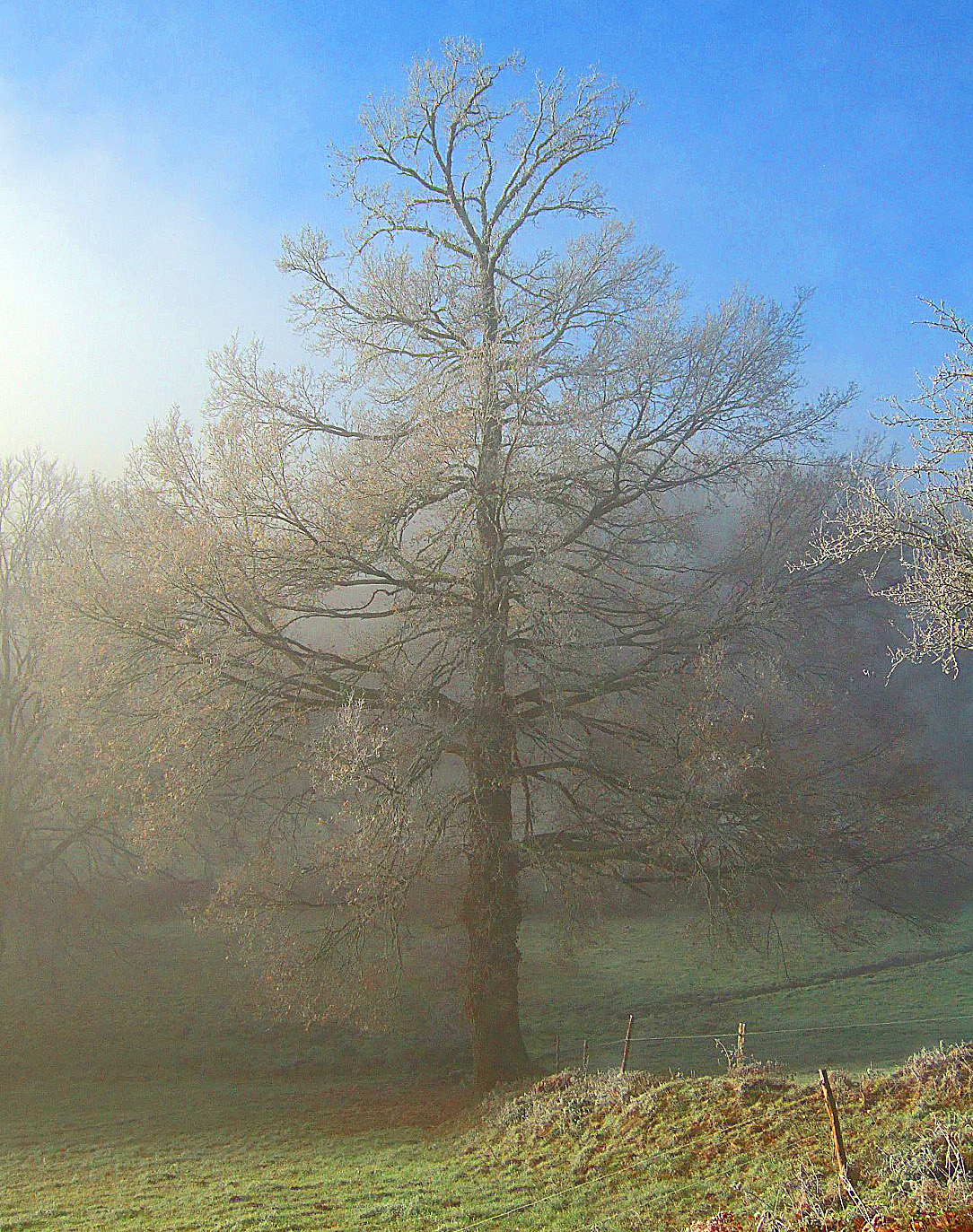
As winter begins to take over in December, there are stunning frosty mornings to enjoy, lots of startling blue skies, the stark beauty of the stripped-down landscape and usually at least one proper snowfall.


By March, we are all weary of the cold, so it is viscerally exciting to notice the buds forming and the first hints of green beginning to shade-in the landscape. For a while, it is as though everything is holding its breath and there is a great sense of anticipation in the air. Then comes a day with a certain balminess in the air and POW! ...it all bursts forth with life. Suddenly, I am again driving about surrounded by greenery and wild flowers. It's hard to express just how uplifting this annual renewal is, but the feeling is impossible to ignore and it affects everyone's spirits.


Then before we know it, les grandes vacances have arrived and everything is once again spooling down towards chestnut time and the smell of woodsmoke in the air.

Friday, 16 December 2011

The Gallic Shrug

I suppose everyone is aware of the infamous Gallic shrug, and unlike many stereotypical characteristics, it not only exists but is an essential tool in the conversational armoury of a French speaker.

Before I lived in France, I had a concept of the Gallic shrug as a gesture encompassing an attractively laid-back attitude; a wry, "Well, that's just the way things are and it's not worth getting your knickers in a twist about it"; a charming counterpoint to the Anglo-Saxon drive to fix everything. It was laissez-faire and c'est la vie and que sera, sera.

The reality of the Gallic shrug is subtly but crucially different. After 10 years here, I have mastered its use. This is what it is really for:

The shrug is a way of disavowing responsibility. The shrug says "Look, you are not seriously expecting me to try to sort this out for you?". The shrug says "Oh, for goodness' sake, it's five to twelve and I want my lunch and I really can't be bothered to try to find a way around this problem". The shrug says "Please, do not attempt to lay this issue at my door because I am perfectly sure without even thinking about it that it must be somebody else's business and not mine".

It is a powerful tool and its judicious use can work wonders. When faced with a builder playing dumb about unsatisfactory work, an obstinate shop-worker refusing a refund for faulty goods, a local government official pursing his lips about some trifling irrregularity in his paperwork or similar, there is no mileage in insisting too forcefully on your rights or pointing out the idiocy of their stance. Simply sit back, adopt a polite and rather vague half-smile and then at just the right moment, throw them a shrug. It will, almost without fail, neatly volley the ball out of your court and back into theirs.

Just make sure you get your shrug in first, though.


Thursday, 15 December 2011

The butcher, the baker, the candlestick maker

People often remark that life around these parts is "Just like the UK 50 years ago". Perhaps this is no more than sentimental nostalgia, but there is certainly a quaintness to the way some things are done.

One of the traditions which persists in spite of modern pressures is the statutory noon-to-2pm lunch, which takes some getting used to. Shortly after arriving here, hubby was driving the lanes on some errand or other when he realised he was in need of refreshment and the time was 11.50am. He knew that after noon there would be no shops open, so he pulled over in the next village, where there was a little row of three shops: baker, butcher and small grocer.

He first tried the baker, where a wizened lady aged about 90 appeared from the back at the sound of the door opening. He asked if she had any ready-made sandwiches. She did not, so he said he would take a baguette and try for some ham or similar in one of the other shops. The lady duly wrapped his bread with painstaking care and wished him a cheery farewell and he bobbed into the butcher next door.

Again, the shop was empty when he entered, and this time he had a wait of a couple of minutes before there was movement from the back and eventually in shuffled ... the same lady. With ne'er a flicker of recognition in her demeanour, she explained apologetically that she didn't have any ham available. Hubby suggested that he would try the grocer and she agreed this might be a good plan.

So, into the next shop, where there was also no sign of life. After a slightly longer wait, he was a bit dumbfounded to be greeted once more by the very same old lady. Again, she behaved as though she had never laid eyes on him before, and he had to repeat the entire conversation before obtaining a couple of slices of ham.

Well, he got his lunch eventually, but you do have to learn not to be in a rush.